
Flow2Spec Design Principles
Problem Statement
❌ Current State                      ✅ After Flow2Spec

Architecture conventions  ──┐         .Knowledge/
Technical designs       ──┼──►  scattered     ├── manifest-routing.json
Module boundaries       ──┤    unstructured   ├── matchers/
Team experience         ──┘    reinterpreted  ├── topics/
                               every time      ├── stock-docs/
                                               └── req-docs/

                                               AI can read the project anytime
Core Design
0. Memory Coding and Four Rings
Memory Coding: encode durable context into the committed repository (PR-reviewable), not private model memory or chat-only context.
Four rings in the repo (rules ring and skills ring are separate—do not merge):
| Ring | Location | Role |
|---|---|---|
| Knowledge | .Knowledge/ | Routing, topics, stock/req docs |
| Task | .task/ | Cross-session continuation, user todos |
| Rules | Tool rules / AGENTS.md | How to read and act |
| Skills | f2s-* / skills/ | Maintain KB, trigger workflows |
Flow2Spec delivers the Memory Coding persistence and maintenance loop, not “another RAG knowledge base.”
0.1 Knowledge Ring: Multi-Layer Memory
Inside the knowledge ring: horizontal narrowing (L0 manifest → L1 matchers → L2 topics → L3 long docs) plus vertical chaining (topicDependencies: common → subdomain → whitelist → domain). The match → expand → verify → act pipeline operates on these layers; see architecture.md §4.
1. Separation of Knowledge and Rules
1.1 Rule Scope and Priority
Flow2Spec rules intentionally overlap in a few places: the global entry defines the overall path, while focused rules enforce one specific stage. This redundancy reduces missed mandatory steps, but agents must resolve overlap by scope priority instead of treating similar wording as conflict.
| Scenario | Priority Rule | Role |
|---|---|---|
| First read / first tool call for ordinary questions | f2s-knowledge-preflight | Decides whether current-repo questions must first read .Knowledge/manifest-routing.json, and governs the gap gate / source fallback rhythm. |
| Source fallback closing for ordinary Q&A | f2s-kb-feedback-closing | After answering from source code, all four cases must take an explicit stance: cases 1–3 emit a f2s-kb-distill suggestion; case 4 emits an explicit “knowledge base already covers” marker. Silently skipping the entire closing step is forbidden. |
| Global routing facts / progressive loading chain | f2s-flow2spec-unified-entry | Defines the source-of-truth relationship and read order for manifest, matcher, topic, stock-docs, and req-docs. |
Reading config before any f2s-* skill | f2s-config-check | Enforces flow2spec.config.json as the first step of every f2s-* skill. |
| Implementing from a technical proposal | f2s-implement-tech-design | Full execution rule for implementation from a technical design. |
stock-docs / req-docs boundary | f2s-stock-docs-vs-req-docs | Defines the path responsibilities of persistent context vs requirement / technical proposal documents. |
| Writing topics / metadata / dependencies | f2s-topic-authoring | Authoring-side rule for topic naming, granularity, classification, dependencies, and persistence. |
| Task checklist maintenance | f2s-task | Governs .task/ creation, continuation, and archival. |
| General coding discipline | f2s-karpathy-guidelines | Supplemental coding discipline only; it must not override mandatory f2s workflows. |
Core principle: gate rules decide whether something must be read or whether an action is allowed; focused rules then define how to execute it. If rules overlap, apply the scenario priority above.
2. Progressive Routing
3. Skill Maintenance Loop
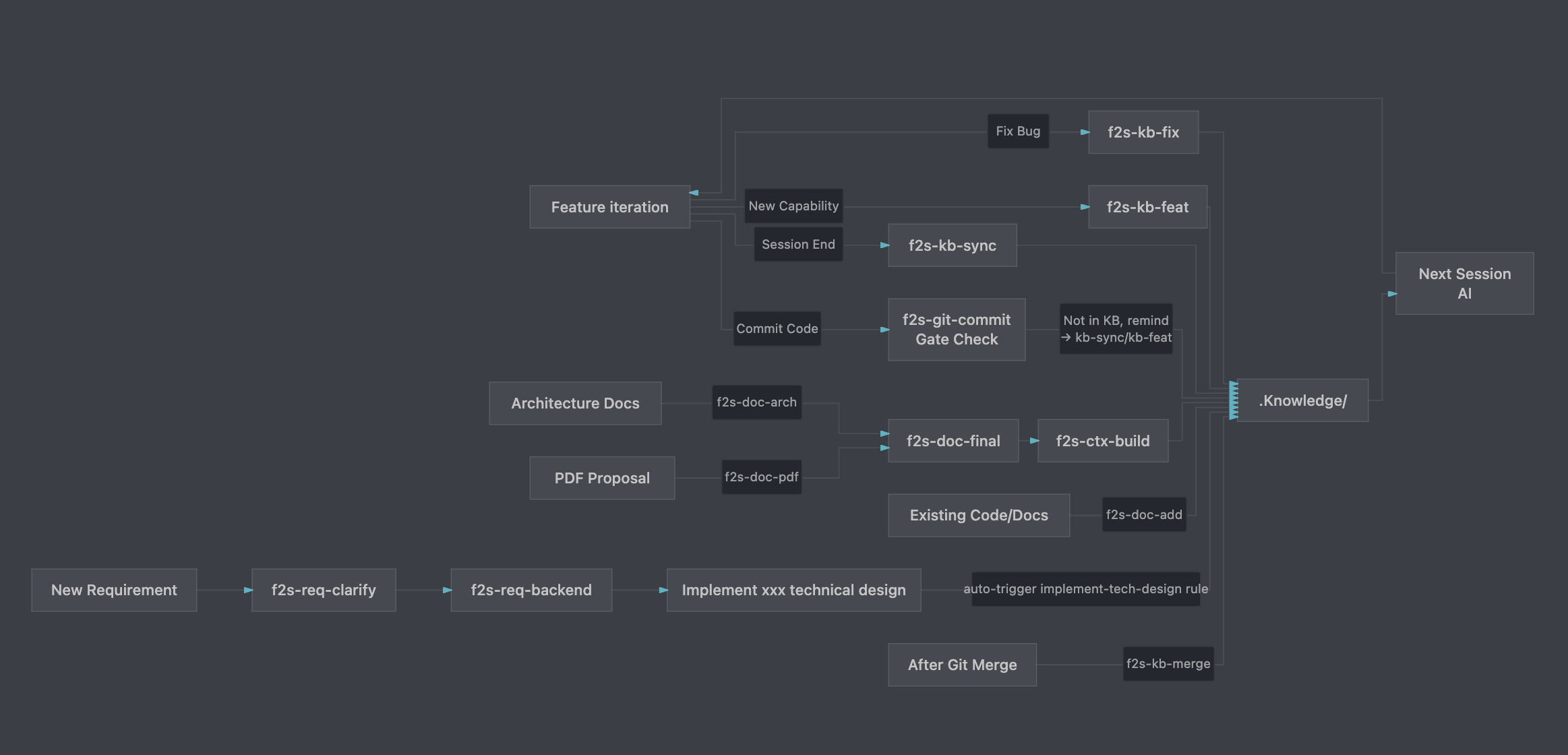
Mermaid source
Seven entry points · f2s-git-commit is the knowledge discipline gate at commit time · .Knowledge/ is the single convergence point · Knowledge drives AI, AI drives the next development cycle
4. Task Checklist and Cross-Session Continuation
Tasks do not get lost when a session ends · Keywords enable automatic continuation without re-explaining context · Skill constraints are fully restored
5. Ownership of Collaboration State
Early versions committed .task/ like ordinary project files. Team use exposed its real ownership: todo.json and active/ describe one developer’s Agent session, not project truth.
Old
  .task/ -> Git -> everyone shares one todo.json

Current
  .task/alice/ -> Alice resumes locally
  .task/bob/   -> Bob resumes locally
  .Knowledge/  -> Git -> shared team facts
The current developer’s TASK_ROOT owns progress. Code, formal documents, and .Knowledge/ own the delivered capability. developerId remains useful on shared machines and as an Agent read boundary; it is not a remote identity or authorization system.
6. Why Knowledge Merges Use Optimistic Locks
.Knowledge/ cannot be split by developer. Flow2Spec uses topic revisions as optimistic disk locks rather than introducing file locks or a remote lock service.
A remote lock would require every writer to share an online service and would add leases, disconnect recovery, stale locks, and CI identities to a local-first Git workflow. A delta instead records the topic revision it read, and plan compares that value with the current file:
baseRevision == diskRevision  -> apply and increment revision
baseRevision != diskRevision  -> stop, reread, and merge semantics
The trade-off is explicit: the lock covers a whole topic, and plan cannot see remote work that has not been pulled. Flow2Spec accepts those limits in exchange for an offline, service-free, reviewable merge path. Frequent conflicts usually indicate that a topic has too many responsibilities.
Design Highlights
A. Routing and Context Loading
1. matchers sharded, not embedded in manifest
❌ Embedded in manifest              ✅ Independent shards

manifest.json (full read every time)   manifest-routing.json
├── task1: keywords:[...]    →          ├── task1 → m-order.json ──► read only this one
├── task2: keywords:[...]               ├── task2 → m-payment.json
└── task3: keywords:[...]               └── task3 → m-refund.json

                                        Updating keywords doesn't touch routing structure
                                        Per-routing token cost is fixed
2. topicDependencies: dependencies on topics
❌ Attached at task level              ✅ Attached at topic level

taskA → [dep, main]               topicDependencies:
taskB → [main]      ← forgot        main: [dep]
taskC → [main]      ← forgot
                                    Any path loading main
Forgot when adding new task          automatically brings in prerequisite
→ silent failure                     dependencies
3. topics store summaries, rules files store full text
.Knowledge/topics/implement-tech-design.md     ← lightweight, loaded during routing
┌──────────────────────────────────────────┐
│ Topic id, path conventions, next pointer │
│ ~100 lines                               │
└──────────────────────────────────────────┘
             ↓ read only after hit
.claude/rules/f2s-implement-tech-design.md     ← full text, loaded during execution
┌──────────────────────────────────────────┐
│ Complete execution constraints,           │
│ mandatory steps, prohibitions,           │
│ boundary descriptions                     │
│ ~500 lines                               │
└──────────────────────────────────────────┘
Routing layer stays lightweight · Execution details load on demand · The two evolve independently
4. Full-scan prohibition is a hard constraint
Read order (mandatory)

  1. manifest-routing.json   ← read the routing table first
  2. matchers/xxx.json       ← read only the matched shard
  3. index.md                ← on demand, confirm semantics
  4. stock-docs / req-docs   ← on demand, supplement context
  5. Business source code    ← last resort

  ❌ Before reading manifest, full-repo unbounded scan is prohibited
  ❌ Within the same task line, manifest already read, do not re-read in full
  ❌ index.md must not be alternated with manifest as a "checklist" to replace decisions
5. Skill trigger words in the description field
name: f2s-kb-sync
description: >
  Sync implemented capabilities to the knowledge base.
  Triggers: f2s-kb-sync, full sync, knowledge base sync, implemented capabilities
User input → Agent scans description for semantic match → triggers corresponding skillTrigger words are in the description field · not in the skill body · higher hit rate · bilingual coverage reduces missed triggers
B. Knowledge Structure
1. stock-docs vs req-docs semantic prohibition
stock-docs/                        req-docs/
Architecture docs / Final draft    Requirements / Technical designs

     ↓ used for                           ↓ used for
Knowledge routing / Background      Drive coding implementation
reference

     ✅ May be read                      ✅ May be read
     ❌ Cannot be used as coding input    ✅ Input for implement-tech-design
Prevents: driving implementation with outdated reference docs → code diverging from the latest design
2. init is idempotent
flow2spec init   can be safely re-run

        ✅  Does                         ❌  Does NOT
┌─────────────────────┐      ┌─────────────────────┐
│ Fill missing         │      │ Write business       │
│ directories/templates│      │ document content     │
│ Install rules/skills │      │ Update routing       │
│                       │      │ keywords             │
│ Align package-level   │      │ Overwrite existing   │
│ structure             │      │ knowledge content    │
└─────────────────────┘      └─────────────────────┘

Structural operations  ≠  Business semantics    The two have no overlapping responsibilities
3. Knowledge versioning
git log .Knowledge/

  a3f1c2  f2s-kb-feat: add refund state machine routing
  b7e9d1  f2s-kb-fix: fix RestTemplate injection conventions
  c2a8f0  f2s-kb-build: onboard order service architecture docs
  d5b3e9  f2s-kb-sync: consolidate payment retry queue design

  Code changes  +  Knowledge changes  →  same commit or adjacent commits
Knowledge has versions · is reviewable · is traceable · is blameable
4. No accumulation of historical negation
❌ Wrong approach (knowledge base grows bloated)        ✅ Correct approach (only current truth)

  RestTemplate convention (updated 2026-05)              RestTemplate must be injected via Bean
  ~~Previously incorrectly used new RestTemplate()~~     Direct new RestTemplate() is prohibited
  → No longer related to direct instantiation
  → Old approach deprecated, now uses Bean injection
Rewrite in place with each fix · don’t layer history · the knowledge base always describes only the present
C. Execution Constraints
1. Mandatory steps are constraints, not suggestions
implement-tech-design execution flow

  Input normalization
      ↓
  Read proposal and context
      ↓
  ★ Output implementation task list    ← cannot skip
      ↓
  ★ Confirm before implementing       ← cannot skip
      ↓
  Implement per task list
      ↓
  Output pending checklist and reminders  ← cannot skip
Suggestions → can be skipped · Constraints → must be explicitly addressed before proceeding
2. fallback is itself a procedurally-defined topic
No match ≠ silent failure · degradation itself has a clear procedure
3. manifest / index write authority hard constraint
Sub-agents MAY write              Sub-agents MUST NOT touch
────────────────────             ────────────────────
Code implementation files        manifest-routing.json  ← always written by main agent
stock-docs content files         .Knowledge/index.md    ← always written by main agent
topics content files (diff mode)
matchers/*.json (diff mode)
When multiple sub-agents run in parallel, shared state files are written single-point by the main agent to prevent concurrent conflicts
4. Document changes vs code changes: different splitting strategies
Code sub-packages                  Document sub-packages
────────────────────             ────────────────────
✅ Can delegate to sub-agents     ❌ Not split by default, main agent writes directly
✅ Sub-agents write directly      If outsourcing is necessary →
                                  Sub-side only outputs before/after diff snippets
                                  Main agent reviews and merges
                                  ❌ Full-file rewrite is strictly prohibited
Rationale: documents need to guarantee “current truth coverage / consistent style / no accumulation of historical negation” · requires the writer to see the full context
5. Task checklist and cross-session continuation
Keyword-based automatic continuation example

  First sentence of a new session: "There's still an issue with payment callback"
      ↓
  Matches each entry's keywords in todo.json
      ↓
  Hit { name: "payment_callback_fix", keywords: ["payment", "callback"] }
      ↓
  Load task.md (show remaining steps)
  linkedSkill = "f2s-kb-fix" → load SKILL.md
      ↓
  Skill's write rules / style requirements / self-check checklist are fully restored
  User doesn't need to re-describe context, can continue directly

  ✅ No need to say "continue the previous task"
  ✅ Skill constraints are fully restored, consistent with the first invocation
todo.json write authority constraint
Main agent ── read / write todo.json ✅
Sub-agent ── read todo.json ✅
Sub-agent ── write todo.json ❌
Rationale: when multiple sub-agents write concurrently,
concurrent writes cause entries to overwrite each otherLifecycle is driven by skills · keyword routing enables cross-session automatic continuation · linkedSkill ensures full restoration of skill constraints
D. Agent Orchestration
1. subAgent × switchAgentVerification are orthogonal
                    switchAgentVerification
                   false            true
     subAgent  ┌────────────┬─────────────────┐
     true →    │ Parallel    │ Parallel         │
               │ execution   │ execution         │
               │ Writer-side │ Sub writes→Main   │
               │ self-verify │ verifies          │
               │             │ Main writes→Sub   │
               │             │ verifies          │
               ├────────────┼─────────────────┤
     false →   │ Sequential │ Sequential         │
               │ execution  │ execution          │
               │ Main agent │ Main agent         │
               │ self-      │ self-verifies      │
               │ verifies   │ (no sub-side       │
               │            │  for cross-check)   │
               └────────────┴─────────────────┘
Two orthogonal dimensions · independently configurable · default is bottom-left
2. Confirmation authority cannot be delegated to sub-agents
User dialogue only flows through the main agent · confirmation decisions cannot bypass the user · sub-agents only execute, never decide
3. Skills can override global subAgent configuration
flow2spec.config.json        f2s-req-clarify SKILL.md
subAgent: true               This skill does not split by default:
                             regardless of subAgent value,
                             the clarification process stays
                             entirely in the main session

Rationale: requirement clarification depends heavily on continuous same-session follow-up
           splitting would break context, degrading clarification quality
Global configuration is the upper bound for allowing splits · each skill decides for itself whether splitting is appropriate · config being true does not guarantee splitting
4. f2s-kb-sync: outline first, write after confirmation
Writing is a destructive operation · the outline is the user’s only chance to correct · nothing is written before confirmation
5. Zero-input inference
f2s-kb-sync three input modes

  Mode 1: User explicitly provides capability list   "Sync the refund state machine into the knowledge base"
  Mode 2: User provides supplementary materials      @src/refund/ @docs/proposal.md
  Mode 3: Zero input                                "f2s-kb-sync" (just this one sentence)
                                       ↓
                                  Agent infers based on session context
                                  what was implemented and what is worth consolidating
Session context itself is an information source · no need for users to organize and re-input
5.1 How execution switches reach the Agent (multi-platform prompts)
flow2spec.config.json determines subAgent / switchAgentVerification / changeTracking, but AI products do not guarantee that the file is automatically opened at session start. The design uses multiple weak constraint layers to reduce the probability of “running f2s-* without reading the config”, while avoiding maintaining a verbose duplicate of .codex/topics/f2s-config-check.md in .Knowledge:
| Mechanism | Design Intent |
|---|---|
Cursor f2s-config-check.mdc | Rule-layer enforcement: “Read before skill body”; Cursor hooks are used for update checks only, not automatic config reads. |
Claude f2s-config-session SessionStart | Injects one config summary when the conversation starts, reducing the chance that the setting is forgotten. |
Claude f2s-config-inject PreToolUse | Only guards f2s-* Skill calls by reminding the agent that the first skill-body action must be Read; it no longer repeatedly injects the full config. |
Codex AGENTS.md / .codex/topics/f2s-config-check.md + f2s-config-session | One SessionStart configuration summary plus text-layer enforcement: “Read before skill body”; there is still no Claude-style PreToolUse Skill guard. |
Codex AGENTS.md + renderProjectConfigBlock | Top-level Read hard constraint + field-semantics table; current values only come from disk Read and the SessionStart summary. |
Knowledge base config-precheck topic | When routing hits, provides only summary and a pointer to the Codex full text, not a substitute for Read JSON. |
Authority remains the Read result of the project-root JSON; each layer is a prompt, not a second source of truth. For the complete operational table and paths, see Usage Guide § 1. f2s-* and flow2spec.config.json.
6. Skills don’t restate unified entry rules, only reference them
Each SKILL.md's orchestration section reads:

  subAgent / switchAgentVerification semantics
  are defined in the unified entry as the sole source of truth,
  not restated here.
  ↓
  Cursor/Claude → rules/f2s-flow2spec-unified-entry.*
  Codex         → .codex/topics/f2s-flow2spec-unified-entry.md

  15 skills, each only writes its own unique orchestration constraints
  Common rules are defined in one place; modifying one location affects all
E. Pluggable Architecture
1. Tools are pluggable: one knowledge base, any tool combination
flow2spec init <selected-agents>     ← initialize the requested tools
flow2spec init <one-agent>           ← initialize one tool
flow2spec init <selected-agents>     ← add or skip tools as needed

.Knowledge/ stays the same, tools can be added or removed at any time
The same .Knowledge/ drives all tools · adding/removing tools does not affect knowledge content · new tools integrate with zero rebuild
2. Knowledge topics are pluggable: add/remove without side effects
Adding a topic                         Removing a topic
─────────────────────               ─────────────────────
1. Write topics/xxx.md               f2s-kb-rm stock-docs/xxx.md
2. Write matchers/m-xxx.json                  ↓
3. Register in manifest-routing       Automatically cleans up topics/ + manifest
                                       + index references

Other topics remain completely unaffected
New topics simply declare dependencies in topicDependencies · if they don’t, they’re independent · removal has no side effects
3. Skills are pluggable: self-contained units, project-level overrides package-level
Package-level skills (shipped with flow2spec init)     Project-level skills (placed in config root/skills/)

f2s-kb-sync/SKILL.md                  my-domain-skill/SKILL.md
f2s-doc-arch/SKILL.md                 my-review-skill/SKILL.md
...

If names don't conflict they coexist  ·  same name → project-level overrides package-level  ·  they're unaware of each other
Skills describe their own trigger words via the description field · no registry needed · no global config changes needed · effective upon deployment
4. Routing vocabulary is pluggable: shard isolation, local updates
Vocabulary changes only modify the corresponding matchers/m-xxx.json, with zero diff for other routes; see structure in “A. Routing and Context Loading → matchers sharding”.
Vocabulary changes are localized · merge conflicts are minimized · new routes don’t affect existing ones
5. Execution model is pluggable: config switches per project
flow2spec.config.json

  subAgent: false               → main agent throughout, low overhead, suitable for small projects
  subAgent: true                → allow sub-agent parallelization, suitable for large-scale changes

  switchAgentVerification: false → writer-side self-verify, daily use
  switchAgentVerification: true  → cross-verification, high-confidence critical scenarios

  changeTracking.feat: true        → f2s-kb-feat creates a task checklist by default
  changeTracking.fix: false        → f2s-kb-fix does not create a task checklist by default
  changeTracking.implement: true   → implement-tech-design creates a task checklist by default

  Three orthogonal dimensions · each skill can further refine and override global config
Change one line of config to switch execution strategy · no skill files need modification · new projects work out of the box, existing projects upgrade on demand
Strengths and Limitations
✅ Strengths                         ⚠️  Limitations

Precise context                      Upfront investment: knowledge must be built via skills
└─ Routing loads only relevant docs  Scale threshold: overhead > benefit for small projects

Cross-tool sharing                   Requires team discipline
└─ Write knowledge once, use in all  └─ Skills reduce friction, don't eliminate it

Tool-agnostic                        Learning curve
└─ Switch tools without rebuilding   └─ stock/req boundary, routing structure aren't intuitive

Sustainable
└─ Maintenance tied to development actions
Who Is It For
                       Project Scale
                 Small ◄──────────► Large
         ┌──────────┬────────────┐
    Short │  Not     │  Can use   │
    Term  │  needed  │            │
         ├──────────┼────────────┤
    Long  │  Can use │ Highly     │
    Term  │          │ recommended│
         └──────────┴────────────┘

Best suited when: has scale · long-term iteration · multi-tool or multi-person AI collaboration